
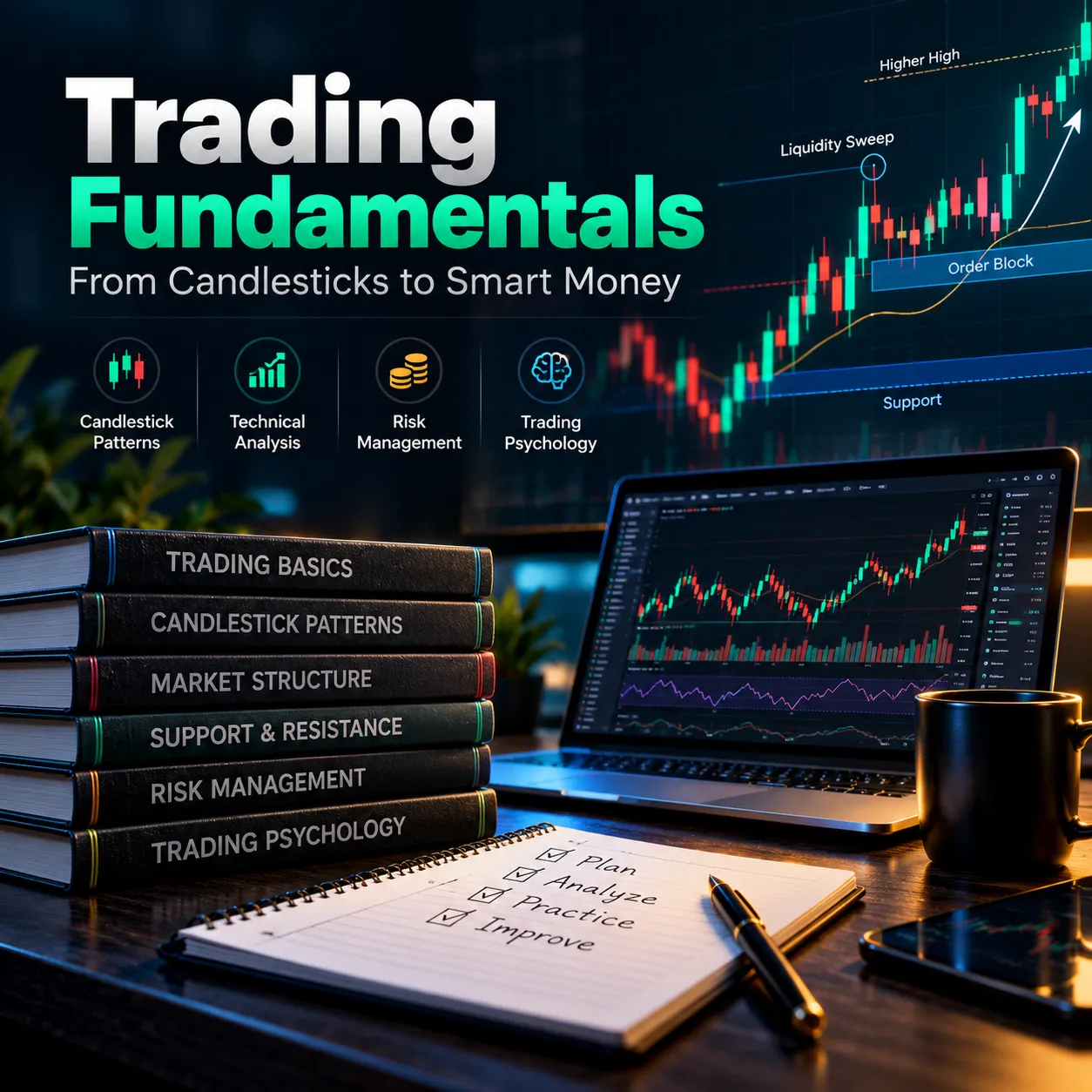
Trading Fundamentals: From Candlesticks to Smart Money
Trading BasicsMaster the foundations of financial trading, candlestick patterns, market structure, liquidity, technical analysis, and risk management through practical, step-by-step lessons.
Course overview.
Trading Fundamentals: From Candlesticks to Smart Money
Build a practical understanding of how financial markets work, how to read candlestick charts, and how to create a disciplined trading plan. This beginner-friendly course progresses from price action basics to support and resistance, liquidity sweeps, multi-timeframe analysis, position sizing, and the responsible use of AI-powered trading tools.
What you will learn
- Understand market participants, order types, fees, and execution risk.
- Read OHLC candlesticks and interpret common patterns in context.
- Identify trends, ranges, swing highs/lows, and relevant price zones.
- Distinguish genuine breakouts from potential liquidity sweeps.
- Use volume, volatility, and multiple timeframes for confirmation.
- Plan entries, invalidation points, stop losses, and profit targets.
- Calculate basic position size and recognize leverage risks.
- Keep a trading journal and interpret AI signals as decision support.
Who this course is for
New traders and early-stage traders who want a structured foundation before attempting a repeatable strategy. No prior trading experience is required.
Course format & assessment
14 self-paced text lessons, practical exercises, and a 20-question multiple-choice final exam. A score of 70% or higher is required to pass. Estimated study time: 3–5 hours plus independent chart practice.
Educational content only. Trading involves substantial financial risk, including loss of capital. Examples are simplified and are not financial advice, personalized recommendations, or guarantees of results.
Course curriculum.
14 learning steps
Step 1 · What Trading Is—and What It Is Not TEXT · Preview available
What Trading Is—and What It Is Not
Lesson objective
Understand markets, instruments, participants, and why trading success should be measured by process rather than by a single winning trade.
1. Trading in simple terms
A trade is the act of buying or selling an asset or contract with the expectation that its market price will move. Instruments include stocks, foreign exchange (FX), commodities, and cryptocurrencies. The way ownership, settlement, fees, and market hours work varies significantly between instruments and jurisdictions.
Spot trading usually involves exchanging one asset for another. Derivatives such as futures or perpetual contracts track a price or reference asset and can involve margin, leverage, funding payments, and liquidation risk. Do not assume rules from one market apply to another.
2. Market participants
Retail traders, institutions, market makers, hedgers, and long-term investors may participate for different reasons. Price changes because market participants accept transactions at new prices; no single chart pattern explains every move.
3. Trading vs. investing
Investing often emphasizes longer-term ownership or exposure. Trading generally involves a defined entry, invalidation level, target, and shorter decision horizon. Both require awareness of risk, liquidity, costs, and personal constraints.
4. A process-first mindset
A good decision is not defined only by whether the next trade wins. A well-planned trade can lose, and an unplanned trade can win. Judge the quality of your process by whether you followed a tested setup, sized the risk appropriately, and recorded the outcome.
Practice task
Write a two-sentence definition of your intended market, instrument, and timeframe. Then list three ways you could lose money even when your market direction prediction is correct (for example, fees, slippage, or an unsuitable stop).
Key takeaway: A trade is a risk decision under uncertainty, not a promise of profit.
Learn. Practice. Improve your skills.
Explore structured trading courses, track your lessons and build your market knowledge from your Learning dashboard.