
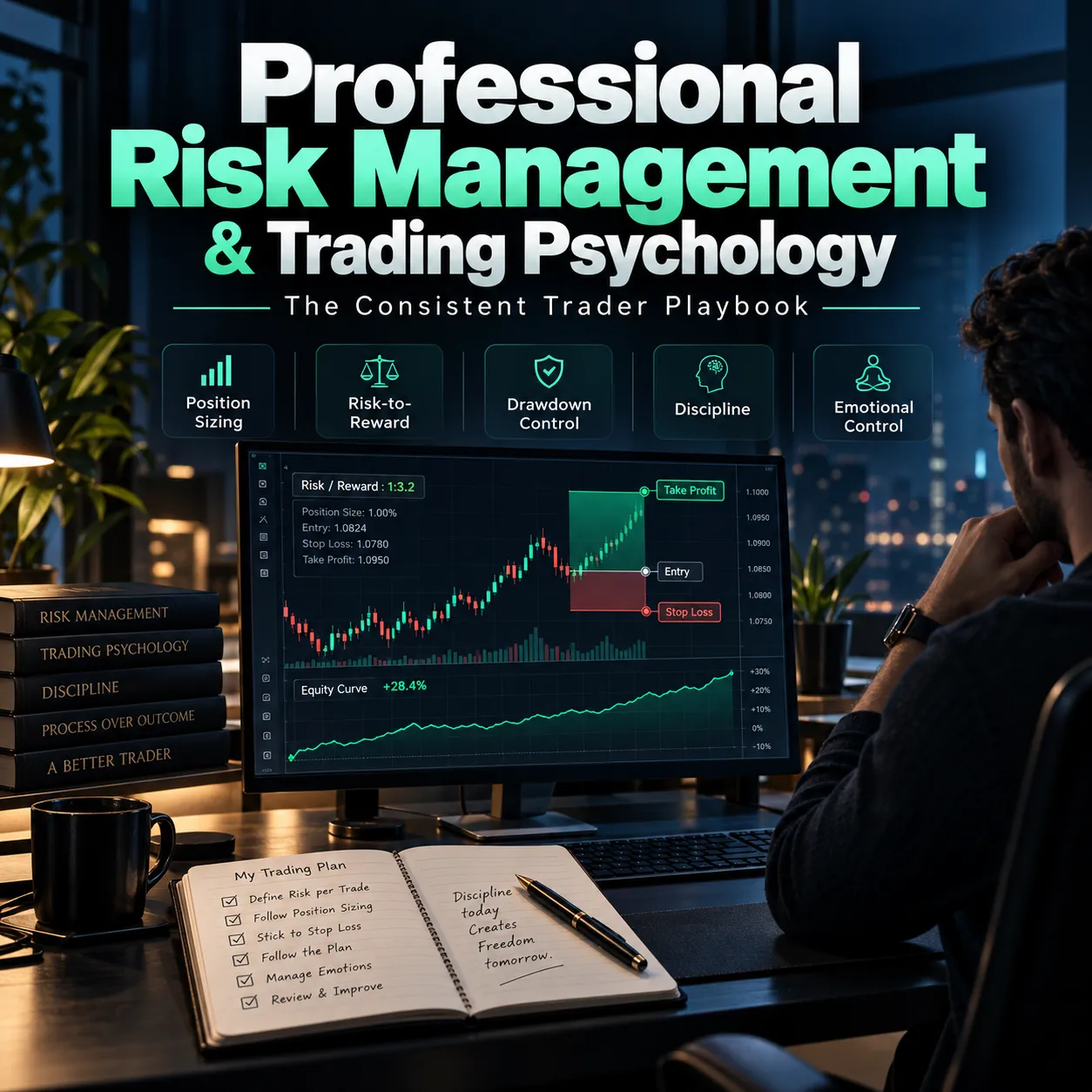
Professional Risk Management & Trading Psychology: The Consistent Trader Playbook
Trading BasicsBuild a professional trading risk framework with position sizing, expectancy, drawdown protection, portfolio exposure control, emotional discipline, and repeatable execution.
Course overview.
Professional Risk Management & Trading Psychology: The Consistent Trader PlaybookLearn to protect trading capital, evaluate opportunities in R-multiples, size positions with clear invalidation levels, and make disciplined decisions when uncertainty and emotions are high. This advanced practical course combines trading mathematics, position management, behavioral science, and a repeatable operating plan.What you will learnDefine risk before the trade: account-based limits, stop placement, position sizing, and realistic transaction costs.Calculate expectancy, payoff ratio, drawdown, required recovery, and portfolio-wide exposure.Understand leverage, derivatives liquidation, correlation, volatility regimes, slippage, and event risk.Build predefined trade-management, daily-stop, and loss-streak protocols without changing rules impulsively.Identify FOMO, overconfidence, revenge trading, recency bias, and process drift; write rules to reduce their impact.Maintain an evidence-based trading journal and run fair backtests and forward tests.Use Chainbey AI chart analytics and alerts as decision support—not as a substitute for personal risk controls.Complete a full case study that includes position sizing, portfolio heat, a trade journal, and a post-trade review.Designed forTraders who already understand candles, orders, basic market structure, and stops, and want to develop safer, more consistent execution habits across FX, crypto, and other liquid markets.Course format18 detailed text lessons with worked examples, exercises, and a 30-question final exam. The exam passing score is 70%. Complete the required steps and pass the exam to qualify for a certificate under the Learning Portal's configured issuance rules.Important noteAll numbers are illustrative educational examples. They are not recommendations for your account. No trading approach guarantees profits; spreads, commissions, funding, overnight gaps, and slippage can make realized results worse than planned. Broker, exchange, contract, and local regulatory rules vary.
Course curriculum.
18 learning steps
Step 1 · Professional Risk Thinking: Survival Comes First TEXT · Preview available
Professional Risk Thinking: Survival Comes First
Learning objective
Shift from predicting the next market move to controlling the cost of being wrong.
1. A trader manages distributions, not certainties
Each trade is a probabilistic event. A beautiful chart setup can lose; a poorly planned setup can win. A good decision means using a repeatable setup, a defined invalidation condition, appropriate exposure, and documented execution—not simply collecting a profitable outcome.
The primary job of risk management is to make sure an unfavorable sequence does not end your ability to keep learning or trading. This is especially important when instruments are leveraged, volatile, illiquid, or exposed to weekend gaps.
2. What is controllable?
You often cannot control the next candle, but you can influence which instruments you trade, your order choice, risk budget, position size, holding period, maximum exposure, and whether to step aside. Stops reduce risk but cannot guarantee a fixed loss if price gaps or fills slip.
3. Separate three layers
- Strategy risk: Is there statistical evidence the entry method has an edge?
- Execution risk: Spread, commission, funding, order errors, and slippage.
- Behavioral risk: Overtrading, moving stops, chasing entries, and increasing size after losses.
Example: A setup with positive backtested expectancy can still be unprofitable if live spreads double during news or the trader repeatedly breaks entry criteria.
Practice
Write one rule for each layer. Define what will make you refuse a trade even when your market bias feels strong.
Key takeaway: Long-run participation requires a survivable process; no single forecast deserves unlimited risk.
Learn. Practice. Improve your skills.
Explore structured trading courses, track your lessons and build your market knowledge from your Learning dashboard.