
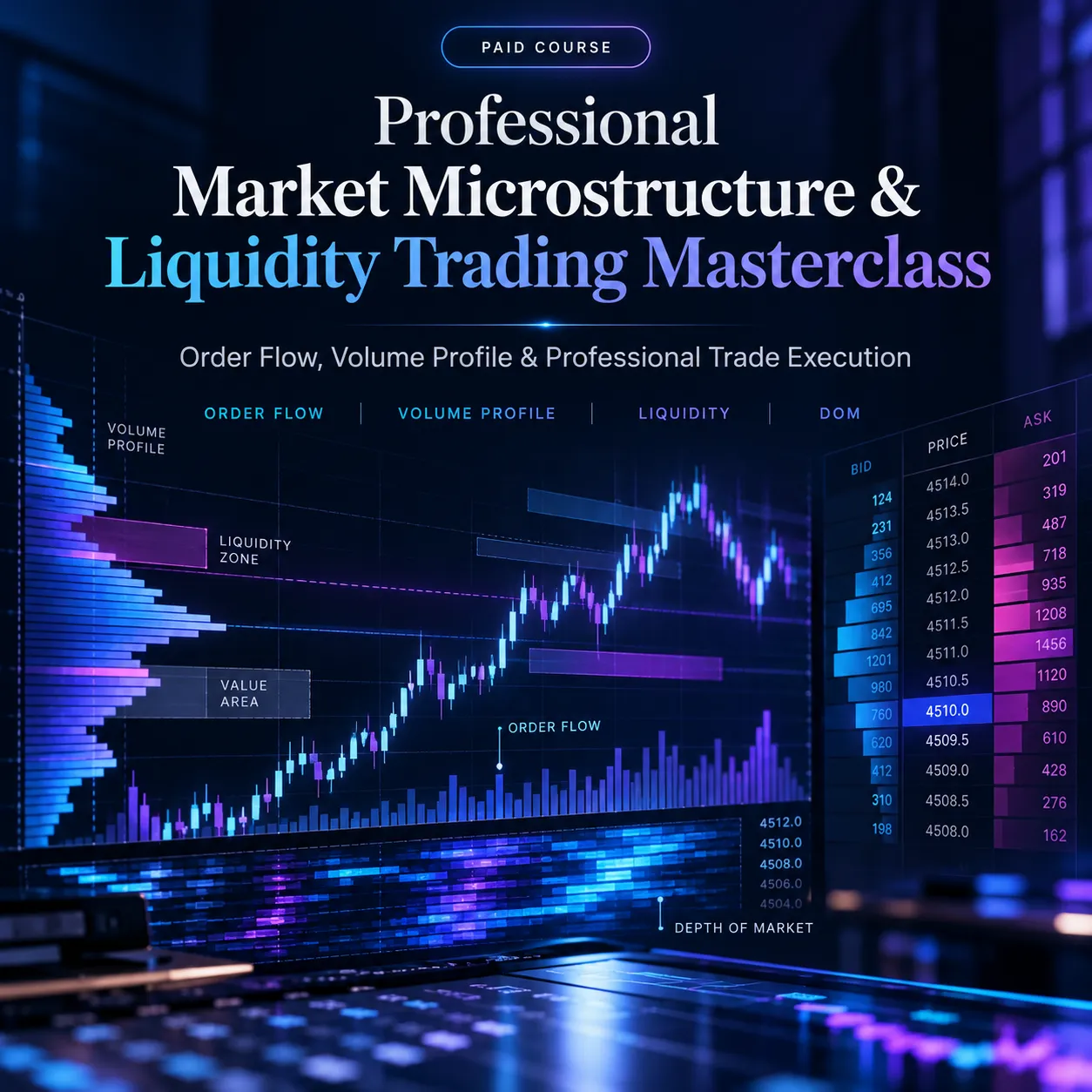
Professional Market Microstructure & Liquidity Trading Masterclass: Order Flow, Volume Profile & Execution
Trading ProfessionalLearn professional order-flow analysis, order-book liquidity, CVD, footprint, volume profile, VWAP, futures funding and realistic trade execution with illustrated lessons.
Course overview.
Professional Market Microstructure & Liquidity Trading MasterclassPremium illustrated text course | 27 illustrated steps | 50-question final exam | Advanced levelLearn how bid/ask quotations, matching engines, depth, trade prints, order flow and price-volume distributions interact. Build evidence-based analyses of liquidity, absorption, market impact and execution cost. Each of the 27 lessons includes an embedded instructional diagram, a worked example and an applied exercise. Graphics are schematic and not actual trades.Included topicsBid, ask, spreads, order types, queue priority and cost-aware execution.Level 2 order book, depth, tape, delta, cumulative delta and footprint.Potential absorption, iceberg replenishment, and observable cancellation patterns without speculation about intent.VWAP, HVN/LVN volume profile, auction acceptance and regime analysis.Stops, forced liquidations, funding, basis, slippage and portfolio risk.Chainbey AI Liquidity & Sweep Intelligence and Smart Money Pressure as decision-support inputs.Timestamp-safe research and a capstone professional trading dossier.Audience & prerequisitesExperienced intermediate traders and analysts who understand candles, stops, leverage, and market structure. Suitable for crypto perpetuals and markets with reliable exchange or broker execution data. Order-flow feed access and definitions vary across markets, so adapt exercises to available data.Completion and certificateComplete all 27 steps and score at least 80% (40/50) on the final MCQ assessment to satisfy the academic requirement for certificate eligibility, subject to the portal’s configured certificate policy.Important disclosureFor education only; not investment advice or a guarantee of profitable trades. Market microstructure inferences are uncertain, and execution costs, exchange outages, leverage, gaps and liquidations can cause rapid losses.
Course curriculum.
27 learning steps
Step 1 · How Markets Match Orders: Auction & Price Discovery TEXT · Preview available
How Markets Match Orders: Auction & Price Discovery
Learning objectives
Describe exchanges as matching engines rather than machines that predict price.
Lesson visual — How Markets Match Orders: Auction & Price Discovery

Visual note: Diagram is schematic, not a live chart, trading signal, or proof of market-maker activity.
Professional explanation
In a continuous limit-order market, buyers and sellers submit instructions. A limit order states the worst price a participant accepts; a marketable order crosses the spread and consumes available resting liquidity. Last-traded price is the price of an executed transaction, not a universal fair value. Different venues, sessions, and instruments can show different available liquidity.
How to interpret the evidence
Start with the instrument, venue and exact observation window. Record what is directly observable (quotes, trades, timestamps, volume, or price) and separate it from assumptions about hidden intent. Check feed completeness and execution costs before converting an observation into a rule. When two explanations fit the same data, state both and design a test that could distinguish them.
Worked example
An offer rests at 100.02 for 80 units. A market buy of 20 units may execute at 100.02 if those units remain available, but a much larger buy can sweep additional offers at worse prices.
Applied exercise
Draw a three-level order book. Identify which orders can rest and which cross immediately.
Professional checklist
- Define the data source and observation interval.
- State a measurable condition and its invalidation.
- Include spread, fees, slippage and exposure limits.
- Record contradictory evidence and a no-trade case.
Key takeaway
Price is discovered through executed orders; charts alone do not expose the entire book.
Learn. Practice. Improve your skills.
Explore structured trading courses, track your lessons and build your market knowledge from your Learning dashboard.