
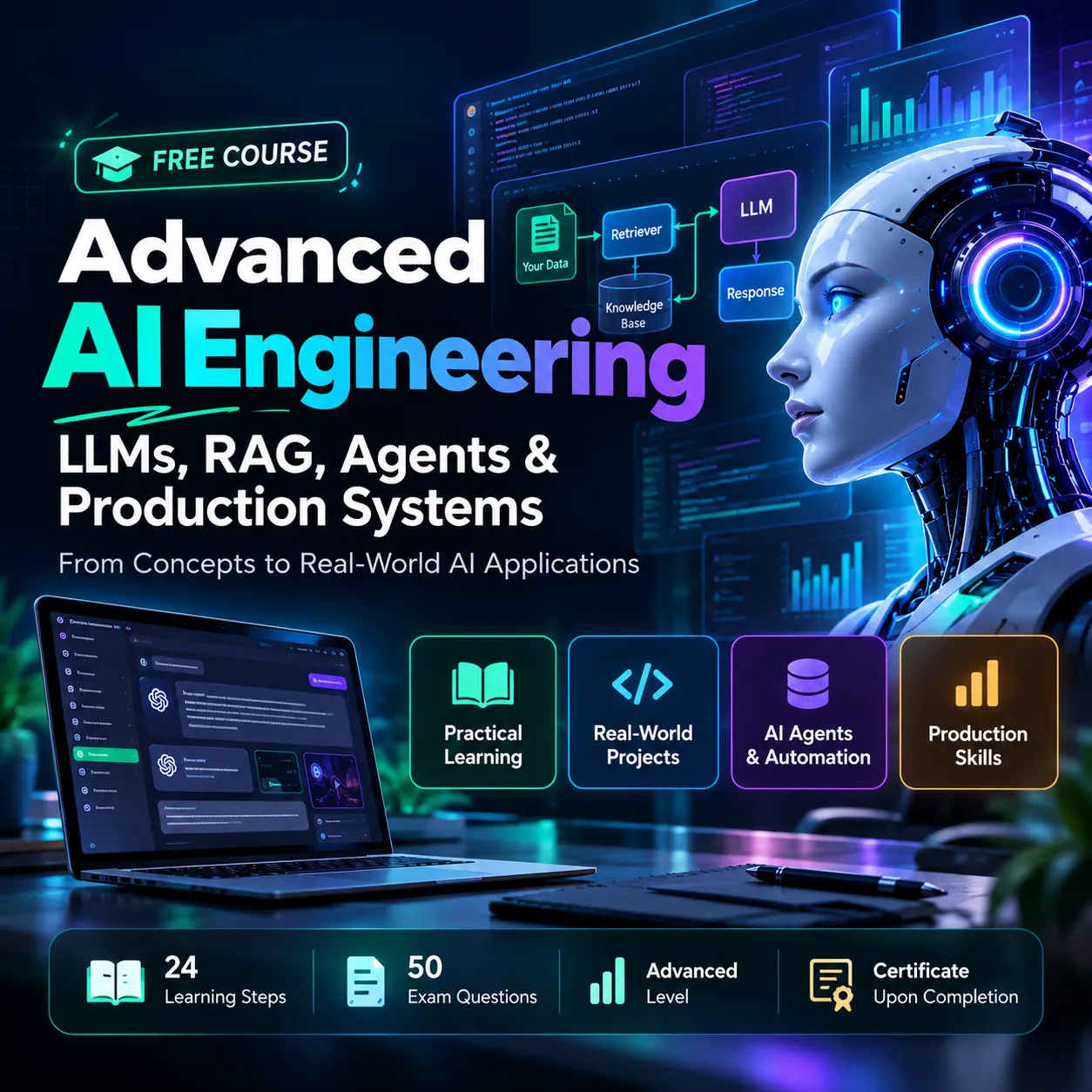
Advanced AI Engineering: LLMs, RAG, Agents & Production Systems
AI & TechnologyA FREE advanced, illustrated AI engineering course covering transformers, prompts, embeddings, RAG, autonomous agents, multimodal systems, evaluations, security and production deployment.
Course overview.
Advanced AI Engineering: LLMs, RAG, Agents & Production SystemsFREE | 24 practical text lessons | 48 unique embedded Base64 PNG infographics | 50-question final exam | Advanced levelBuild reliable AI applications from first principles to production. Learn task scoping, classical ML evaluation, transformer and token concepts, schema-safe prompting, vector search, secure RAG, grounded citations, hybrid retrieval, model tools, bounded agents, context memory, multimodal workflows, fine-tuning decisions, regression evaluations, production observability, OWASP-style security controls, privacy and responsible AI practices.Learning formatEach step has two different, lesson-specific embedded PNG diagrams inside the Rich Text Markdown field, detailed explanations, a worked case, implementation playbook, common failure and hands-on assignment. No separate image file or external image hosting is required by the JSON.Final examination & certificateThe 50-question MCQ exam covers terminology, architecture design, safe application behavior and production tradeoffs. Pass with at least 80% (40/50). Certificate availability follows the Learning Portal completion, assessment and QR verification settings.CapstoneDesign, test and document an evidence-grounded AI assistant with permissions, citations, evaluations, staged rollout and monitoring.Important noteDiagrams are original educational illustrations. Model capabilities and provider APIs evolve; confirm current provider specifications before implementation. Educational material is not a guarantee of performance.Further readingNIST AI RMF Generative AI Profile: https://www.nist.gov/publications/artificial-intelligence-risk-management-framework-generative-artificial-intelligenceOWASP Top 10 for LLM Applications: https://genai.owasp.org/llm-top-10/AI tool design and tool calling: https://developers.openai.com/api/docs/guides/toolsFile search and retrieval: https://developers.openai.com/api/docs/guides/tools-file-search
Course curriculum.
24 learning steps
Step 1 · AI Product Thinking: Problems, Users & Success Criteria TEXT · Preview available
AI Product Thinking: Problems, Users & Success Criteria
Learning outcomes
By the end of this module, you should be able to explain ai product thinking: problems, users & success criteria, analyze a realistic implementation and defend a safe design choice using evidence.
Infographic 1 — AI USE-CASE CANVAS

Core concepts
An advanced AI system begins with an observable user problem, not a model choice. Define the task, the decision being assisted, the cost of an incorrect answer, and the human who approves the result. Separate deterministic tasks such as calculations from ambiguous tasks such as summarization. Prefer the smallest dependable system that meets the acceptance criteria. A well-scoped AI feature has an owner, clear inputs and outputs, allowed actions, failure handling and measurable business value.
Engineering interpretation
Separate what the model can suggest from what the trusted application must guarantee. Keep evidence, authorization, validation and measurement visible in your design. A sensible first implementation is a small baseline that can be tested on normal, ambiguous and failure cases.
Infographic 2 — DECISION BOUNDARIES

Worked case study
A support assistant should answer policy questions from approved documents. It should not independently grant refunds. Success may mean high grounded-answer accuracy, a low escalation rate for straightforward cases and zero unauthorized refunds.
Implementation playbook
- Interview the user and owner.
- write ten representative queries.
- map data access.
- define the rejection and escalation rules.
- record expected quality, latency and operating cost.
Production decision checklist
- What is the exact user objective and what evidence supports the output?
- What inputs or outputs are not trusted by default?
- Which action requires application permission or human approval?
- What is the expected behavior for missing data, tool failure or ambiguity?
- How will quality, latency, cost and unexpected failures be measured?
Common mistake & safer alternative
Avoid: Starting with an autonomous agent before mapping the actual process and risks.
Prefer: Start with a measurable, reviewable baseline; add complexity only when evaluations show an improvement.
Hands-on lab
Create a one-page AI feature specification with users, inputs, outputs, three failure cases, guardrails and five acceptance tests.
Deliverable
Submit a diagram or decision table, one normal-case test, one failure-case test and a short paragraph describing the remaining limitations.
Knowledge check
- Can you explain the difference between the intended behavior and a verified result in this module?
- Can you describe one way that ai product thinking: problems, users & success criteria could fail in production?
- Can you state a test that would expose that failure before launch?
Key takeaway
Reliable AI systems require explicit evidence, controls and measurable outcomes; apply them to ai product thinking: problems, users & success criteria.
Learn. Practice. Improve your skills.
Explore structured trading courses, track your lessons and build your market knowledge from your Learning dashboard.